Go back to former couplet |
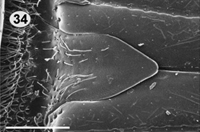
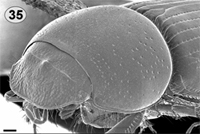
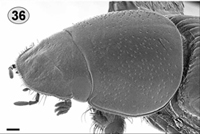
23. Scutellum narrowed at base, pentagonal (Fig. 34); head with tubercles on frontal suture (Figs. 35–
36) ........................................................................ 24
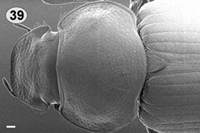
- Scutellum broadly triangular, not narrowed at base; head lacking tubercles on frontal suture (Figs. 39, 58–
62, 66–68) ........................................................ 25
 |
 |
 |
| |
|
|
|
|
|
|
|
|
|
|
|
|
|
|
|
|
|
Fig. 34. Aphodius granarius scutellum; Fig. 35. Aphodius
granarius head to elytral base;
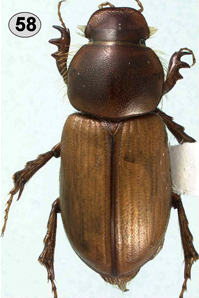
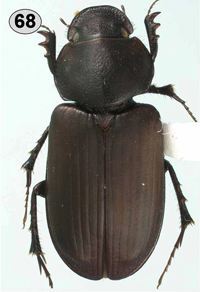
Fig. 36. Aphodius pseudolividus head to elytral base; Fig. 39. Podotenus (Pseudopodotenus) fulviventris head to elytral base. Fig. 58. Orodaliscoides reflexus male habitus;
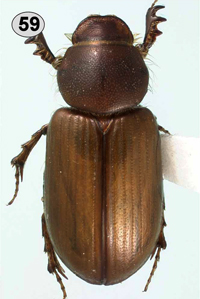
Fig. 59. Orodaliscoides reflexus female habitus;
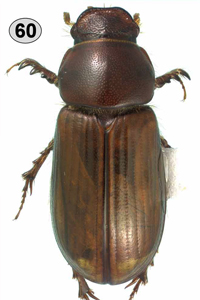
Fig. 60. Orodaliscoides rugosiceps habitus;
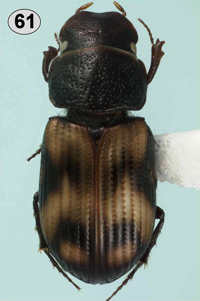
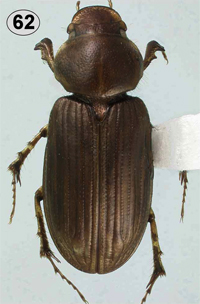
Fig. 61. Acanthaphodius bruchi habitus; Fig. 62. Symphodon anomalus habitus;
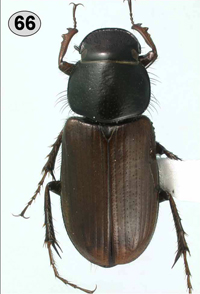
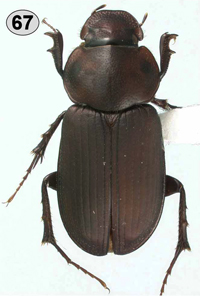
Fig. 66. Podotenus (Paranimbus) sp. male habitus; Fig. 67. Podotenus fulviventris male habitus; Fig. 68. Podotenus fulviventris female habitus. Scale line = 0.2 mm. |
|
| |
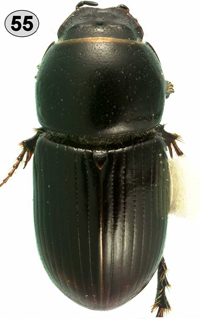
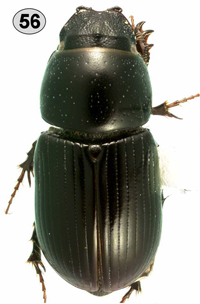
24. Pronotum with distinct, complete basal margin (Figs. 35, 55–56); body black
......................................... Aphodius (Calamosternus) granarius (Linnaeus)
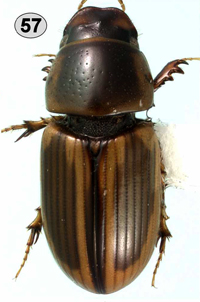
- Pronotum lacking basal margin (Fig. 36); body bicolored (Fig. 57) .............................................. Aphodius (Labarrus) pseudolividus Balthasar
|
| |
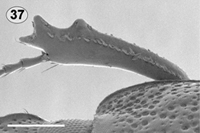
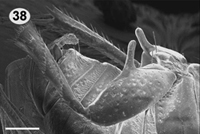
25. Small, less than 5 mm; protibia with apical most tooth projecting forward (Fig. 37); elytra with distinct
color pattern (Fig. 61); male metafemur with distinct medial peg (Fig. 38) ................................................ Acanthaphodius bruchi Schmidt
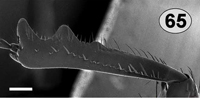
- Larger, greater than 6 mm; protibia with apical most tooth projecting laterally (Figs. 40–42, 63–65); elytra
unicolorous, or with paler apex only; male metafemur lacking peg ............................................................................................... 26
|
| |
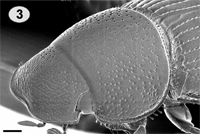
26. Body stout, head convex, clypeal margin strongly reflexed (Figs. 58–60); elytra evenly rounded apically,
without apical umbone (Fig. 3) .................................. 27
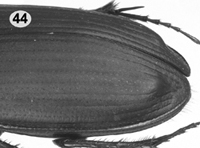
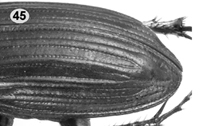
- Body and head flattened (Figs. 39, 62, 66–68); elytra with apical umbone (Figs. 44–45) ...................................................................................................... 28
|
| |
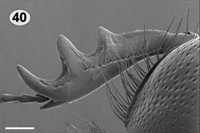
27. Protibia with teeth equally separated (Fig. 40); Argentina ................................................................ Orodaliscoides reflexus (Schmidt)
- Protibia with apical 2 teeth (1+2) closer than next pair (2+3) (Fig. 41); Chile
.............................................................. Orodaliscoides rugosiceps (Harold
 |
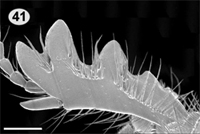 |
Fig. 40. Orodaliscoides reflexus protibia; Fig. 41. Orodaliscoides
rugosiceps protibia. Scale line = 0.2 mm. |
|
| |
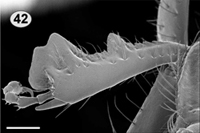
28. Protibial apex modified, bluntly expanded, apical teeth not large (Fig. 42); body dark tan to light brown,
abdomen not orange .... Symphodon anomalus (Harold)
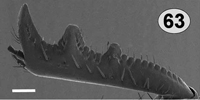
- Protibial apex not modified, not bluntly expanded, apical teeth normally developed (Figs. 63–64); body
black with orange abdomen
........... Podotenus (Pseudopodotenus) fulviventris (Fairmaire and Germain)
|