Project
Summary
This
project will investigate the evolutionary radiation of a group of
endemic dung beetles from South America through monographic research
and applying an integrative method in systematics and biogeography.
This research will provide evidence for evolutionary trends in dung
beetles, historical and ecological biogeography, and conservation
priorities for southern South America.
Members
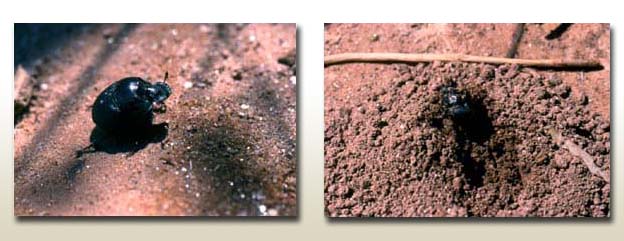
of the dung beetle tribe Eucraniini (4 genera, 16 species) have
traits that make them of interest to evolutionary biologists: they
are flightless (except 1 species), have a unique ecological specialization
on dry dung pellets, and have a unique food relocating behavior.
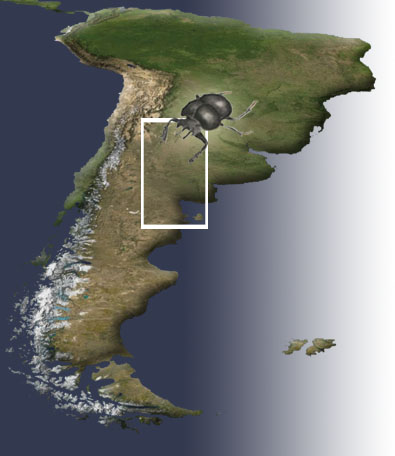
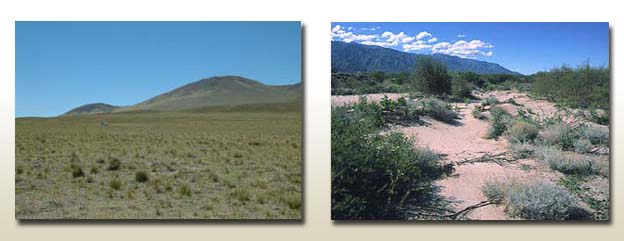
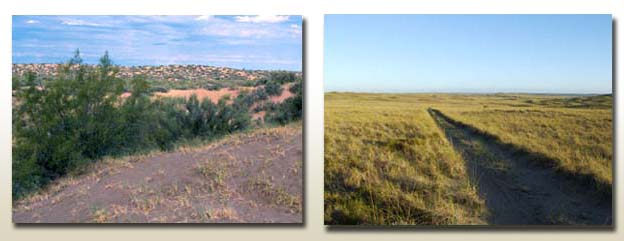
Species of Eucraniini are endemic to desert-scrub habitats of the
Monte biogeographic province in Argentina. These regions have high
levels of endemism, are exploited by humans, and are extremely fragile.
Populations of eucraniine species are isolated geographically and
often exhibit different morphological character states from neighboring
populations.
Speciation
is one of the most intriguing questions in evolutionary biology.
To date, most attempts to infer speciation modes have compared geographic
ranges in relation to phylogenies without considering the environmental
or temporal space. The proposed research will implement a new approach
that integrates phylogenetics, biogeography, phylogeography,
and ecology in order to understand speciation in the Eucraniini,
a monophyletic clade of South American dung beetles.
Species
are considered the fundamental units in studies of ecology, systematics,
conservation biology, and macroevolution. However, the questions
"What is a species?" and "How does speciation work?"
are still two of the most intriguing questions in evolutionary biology.
By applying modern methods in systematics and biogeography to define
species and study speciation in dung beetles, I will be able to
provide empirical evidence to address these crucial questions. The
proposed research will establish species boundaries within this
unique group of dung beetles that could be used forconservation
monitoring and habitat recovery measures in the Monte biogeographic
province.
Results of this project will provide a much-needed foundation in our
understanding of distribution patterns, endemism, and conservation
in the Monte biogeographic province of southern South America.
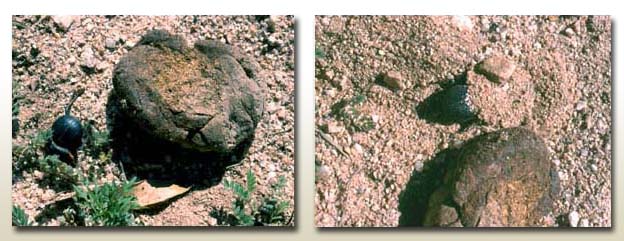
Eucraniini
food relocation behavior
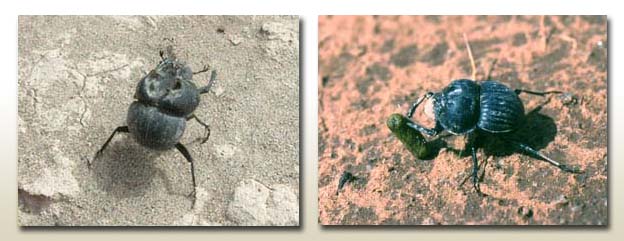
Adults run in zig-zags or randomly
from their burrow (apparently searching for food). To carry the
food, the beetles grasp it with the foretibiae and run forward using
only their middle and hind legs. This behavior is known only for
members of the tribe Eucraniini.
When foraging, species of Glyphoderus
and Anomiopsoides, run on four legs, keeping their forelegs
motionless and in a horizontal position with respect to the surface,
a bahvarior that is known for members if these two genera among
all beetles.
In a second method of food relocation
bahavior, called “butting,” pieces of dung (not formed
into a ball) are rolled by the beetles walking forward and pushing
it with their head and forelegs. This method was observed in Eucranium
arachnoides Brullé.
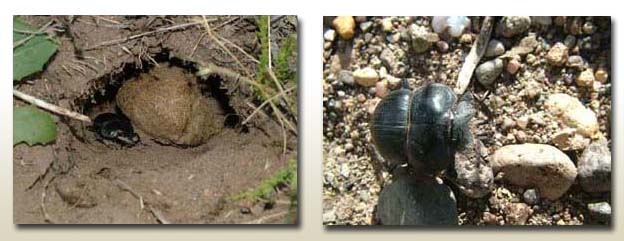
When the entrance of the burrow is
reached, the beetles enter by walking forward rather than backward
as most of the dung beetles do. The burrow is always previously
dug and it is variable in depth.
Detailed descriptions of the biology,
food relocation behavior, and evolution of this unique group of
dung beetles are discused in Zunino et al. (1989, 1991),
Monteresino and Zunino (2003), Ocampo (2003, 2005), and Ocampo and
Philips (2005).
Monteresino, E. M. and M. Zunino. 2003. Sobre el comportamiento
de la alimentación de Eucraniini (Coleoptera: Scarabaeidae:
Scarabaeinae). (Eds. G. Onore, P. Reyes Castillo, and M. Zunino)
pp. 75-80. Sociedad Entomologica Aragonesa. Zaragoza, Spain.
Ocampo, F. C. 2004. Food relocation
behavior and synopsis of the southern South American genus Glyphoderus
Westwood (Scarabaeidae: Scarabaeinae: Eucraniini). The Coleopterists
Bulletin 58: 295-305.
Ocampo, F. C. 2005. Revision of the
southern South American endemic genus Anomiopsoides Blackwelder
1944 (Coleoptera: Scarabaeidae: Scarabaeinae: Eucraniini) with description
of its food relocation behavior. Journal of Natural History 39:
2537-2557.
Ocampo, F. C and T. K. Philips. 2005.
Food relocation behavior of the Argentinian dung beetle genus Eucranium
Brullé and comparison with the southwest African Scarabaeus
(Pachysoma) MacLeay (Coleoptera: Scarabaeidae: Scarabaeiniae). Revista
de la Sociedad Entomológica Argentina 64: 53-59.
Zunino, M., E. Barbero, and M. Luzzatto.
1989. Food relocation behavior in Eucraniina beetles (Scarabaeidae)
and the constraints of xeric environment. Tropical Zoology 2: 235-240.
Zunino, M., E. Barbero, C. Palestrini,
and M. Luzzatto. 1991. La taxocenosi a scarabeidi coprofagi xerico:
materiali per un'analisi biogeografica storico-causale. Biogeographia
15: 41-47.
|