| 1. |
Posterior sternite rounded at apex (females) | |
| 1'. |
Posterior sternite emarginate at apex (males) | |
| 2
(1). |
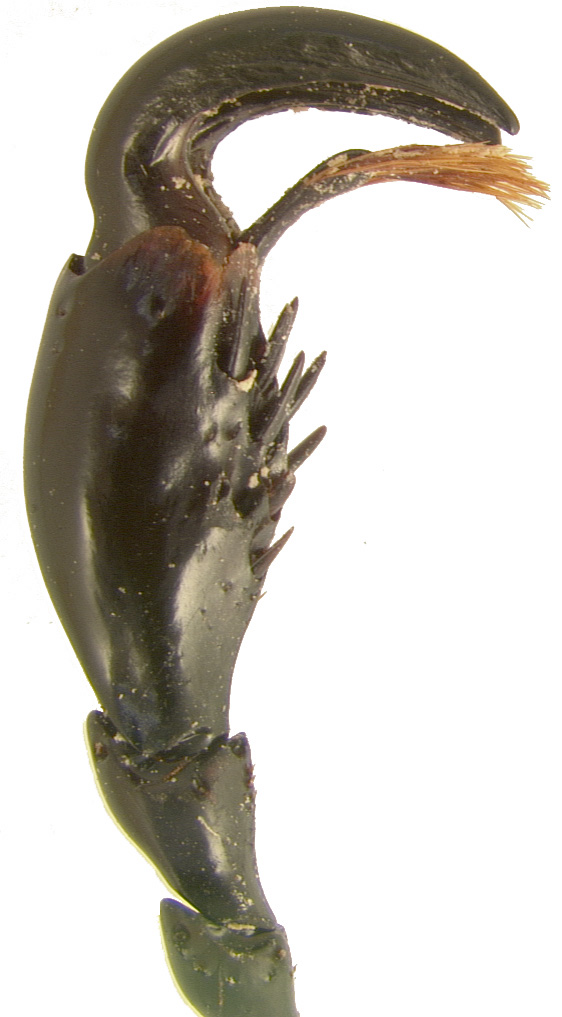
Protarsomere 5 with spinules on venter (Fig. 1) | |||||
| 2'. |
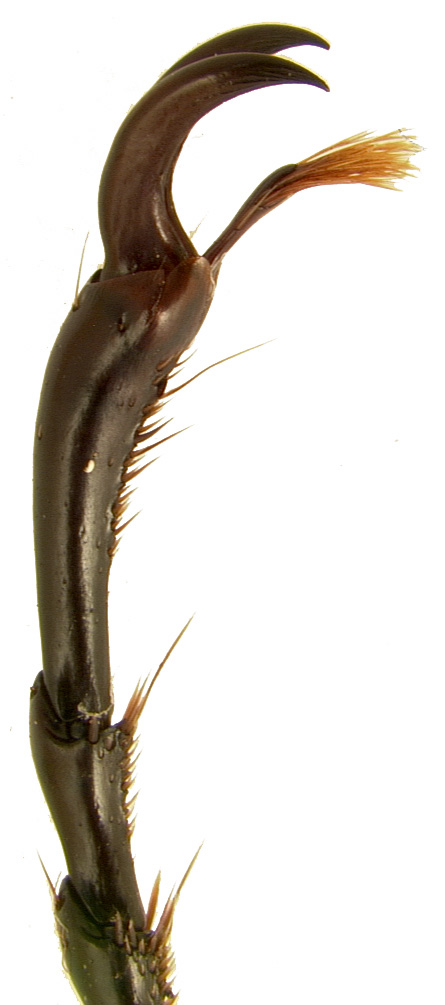
Protarsomere 5 with slender setae on venter (Fig. 2) | |||||
|
||||||
| 3
(2). . |
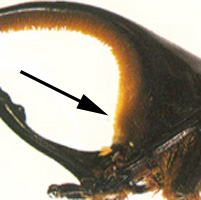
Pronotum without small horns either side below base of pronotal horn (Fig. 3). Bolivia | D.
satanus Moser |
||||
| 3'. |
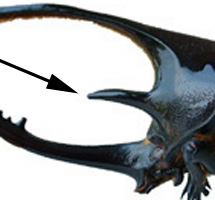
Pronotum with small horns either side below base of pronotal horn (Fig. 4). Columbia, Ecuador, Peru, and Venezuela | D.
neptunus (Quensel) |
||||
|
||||||
| 4
(2). |
Sutural interval of elytra with long, erect setae. Mexico to Brazil | D.
hercules (L.) |
| 4'. |
Sutural interval of elytra without long, erect setae | |
| 5
(4). . |
Pygidial disc with dense, setiferous punctures separated by 2-5 puncture diameters. Mexico, Guatemala, and Honduras | .
6 |
| 5'. |
Pygidial disc with sparse, setiferous punctures separated by 10 or more puncture diameters. United States | .
7 |
| 6
(5). . . |
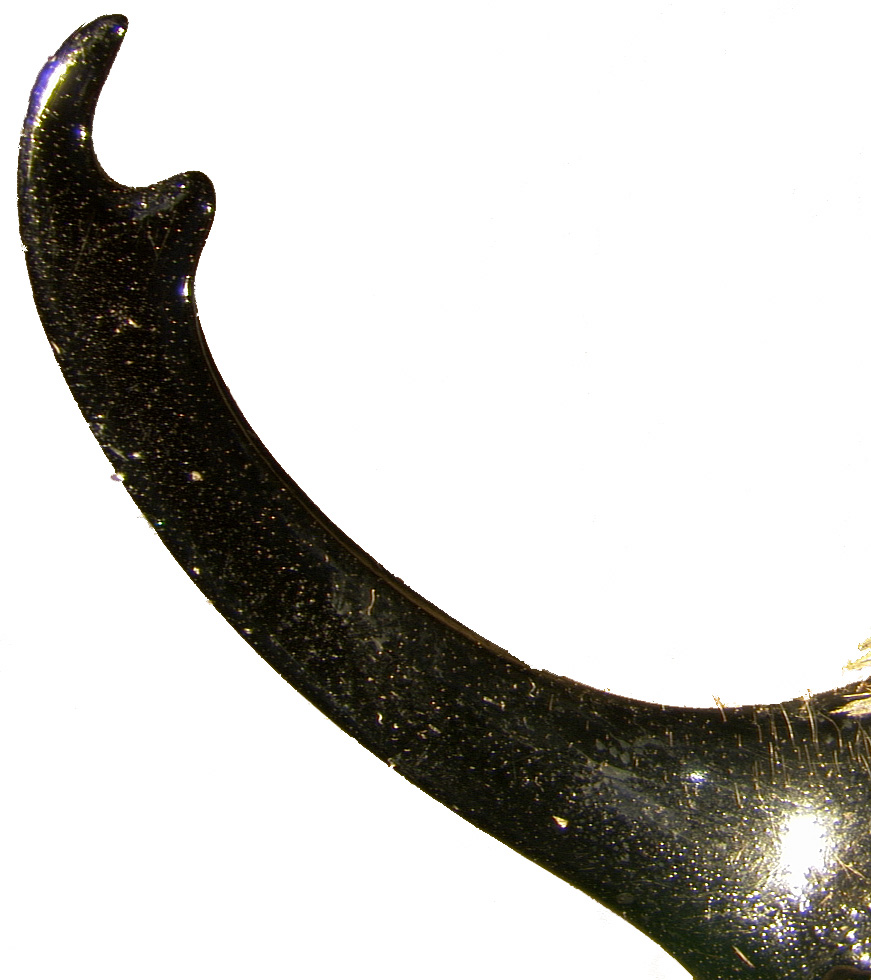
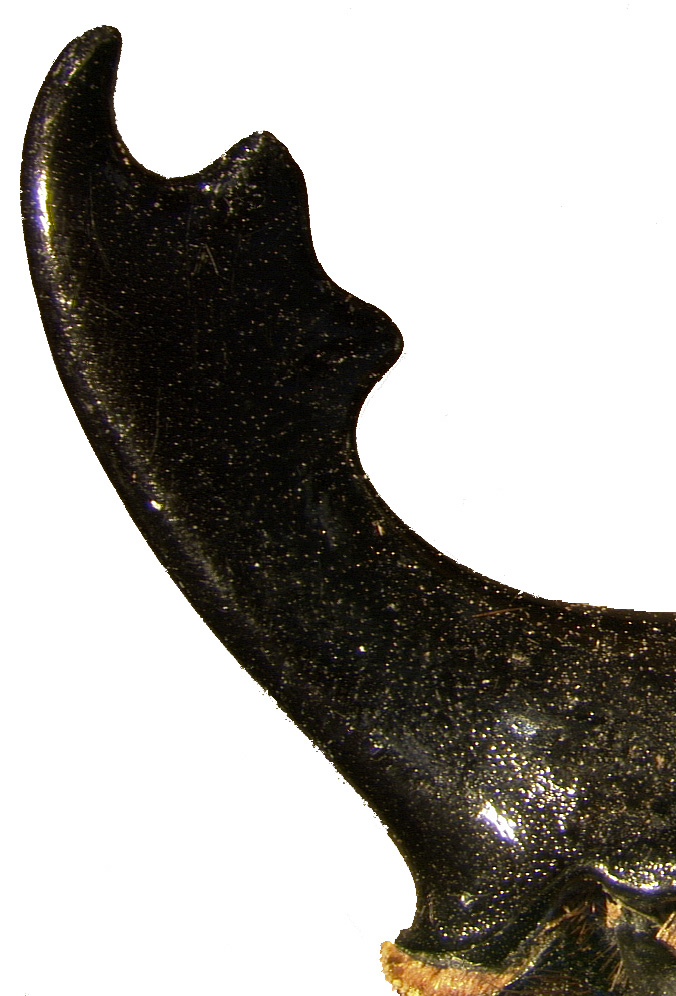
Dark spots on elytra with margins sharp, distinct. Clypeal horn in male majors with dorsal, subtriangular tooth near apex (lateral view) (Fig. 5). Mexico and Guatemala | .
D. hyllus Chevrolat |
||||
| 6'. |
Dark spots on elytra fuzzy, indistinct. Clypeal horn in male majors with dorsal, subrectangular tooth near apex (Fig. 6), or two or more individual, dorsal teeth (lateral view). Mexico, Guatemala, and Honduras | .
. D. maya Hardy |
||||
|
||||||
| 7
(5). . . |
Pronotal horn in male majors shorter than pronotum. Male majors lacking tooth near apex of clypeal horn, apex weakly excised (lateral view). Eastern United States | .
D. tityus (L.) |
| 7'. |
Pronotal horn in male majors longer than pronotum. Male majors with tooth near apex of clypeal horn (lateral view). Southwestern United States | .
D. grantii Horn |
| 8
(1). |
Protarsomere 5 with spinules on venter (Fig. 7) | |||||
| 8'. |
Protarsomere 5 with setae on venter (Fig. 8) | |||||
|
||||||


| 9
(8). . |
Clypeus with apex narrowly
rounded. Bolivia . |
D.
satanus Moser |
| 9'. |
Clypeus with apex acuminate, subtuberculate. Columbia, Ecuador, Peru, Venezuela | D.
neptunus (Quensel) |
| 10
(8). . |
Pronotum with disc densely
setose. Mexico to Brazil . |
D.
hercules (L.) |
| 10'. |
Pronotum with disc glabrous | |
| 11
(10). . |
Pronotum with punctures both apically and basally moderately dense | .
12 |
| 11'. |
Pronotum with punctures dense apically, less dense basally | |
| 12
(11). . . |
Dark spots on elytra with margins sharp, distinct. Pronotum anteriorly with contiguous, vermiform punctures. Mexico and Guatemala | .
D. hyllus Chevrolat |
| 12'. |
Dark spots on elytra with margins fuzzy, indistinct. Pronotum anteriorly with distinct punctures. Mexico, Guatemala, and Honduras | . . D. maya Hardy |
| 13
(11). . . |
Clypeus at apex constricted laterally and weakly emarginate (unworn specimens). Eastern and southeastern United States | . . D. tityus (L.) |
| 13'. |
Clypeus at apex not constricted laterally, broadly truncate and weakly emarginate (unworn specimens). Southwestern United States | .. D. grantii Horn |